{ "prompt_type": "semantic_real_world_reconstruction", "objective"...
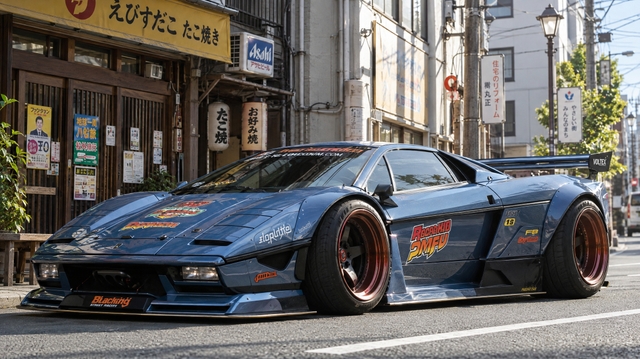
About this AI image
This AI-edited image was created by @fredfraiche on LetzAI on October 31, 2026 using context at 1920 × 1080 pixels (16:9 aspect ratio).
The image was guided by the creator's prompt: "{ "prompt_type": "semantic_real_world_reconstruction", "objective": "Transform the input image into a completely convincing real-world photograph. Use the input primarily to determine what exists in the scene, what the important subjects are, their recognizable identities, their relationships, the general event or situation, and the broad visual idea. Do not treat the source image as geometry that must be faithfully repainted. Reconstruct the scene as if the depicted subjects and situation genuinely existed in the physical world and were photographed there with a real camera.", "fundamental_instruction": { "source_role": "semantic reference and scene concept, not a pixel-level visual target", "target_role": "independent real-world photograph", "core_rule": "The output must be generated from the logic of real photography, not by applying a realistic surface treatment to the source image.", "priority_order": [ "principal subject identity", "recognizable defining characteristics", "scene meaning", "relationship between important subjects", "overall action, pose, or situation", "broad spatial arrangement", "general composition", "source geometry", "minor shapes", "surface details", "textures" ] }, "semantic_extraction": { "instruction": "First determine the minimum set of facts that make the input image recognizably the same scene.", "preserve_strongly": [ "principal subject identity", "subject category", "recognizable design cues", "important clothing or equipment identity", "important vehicle or object identity", "essential pose or action", "important relationships between subjects", "general environment type", "scene narrative", "major directional relationships" ], "preserve_loosely": [ "camera position", "framing", "subject placement", "proportions", "background arrangement", "lighting direction", "secondary objects", "major silhouette" ], "free_to_change": [ "exact silhouette", "exact contour geometry", "surface ornamentation", "small bodywork shapes", "minor architectural geometry", "precise background layout", "camera distance", "camera height", "focal length", "crop", "depth of field", "lighting quality", "weather", "material treatment", "surface texture", "minor pose details", "minor anatomy", "small accessories", "decorative details" ] }, "reconstruction_strategy": { "instruction": "After understanding the scene, mentally discard the source image's rendering style and rebuild the scene from physical reality outward.", "sequence": [ "identify what the scene fundamentally depicts", "identify the few visual facts required for recognizable continuity", "discard synthetic rendering cues", "discard implausible geometry", "discard procedural surface detail", "discard artificial lighting logic", "construct a physically plausible real-world version of the scene", "choose a plausible real camera position and lens", "photograph the reconstructed scene", "reintroduce distinctive source details only when they remain physically believable" ], "critical_rule": "Do not attempt to make every source detail realistic. Some source details should be replaced, simplified, moved, resized, redesigned, or omitted if preserving them would reduce photographic credibility." }, "photographic_manifold": { "instruction": "Bias the reconstruction toward visual patterns learned from genuine photography rather than from renders, concept art, game screenshots, illustrations, synthetic promotional imagery, or AI-generated imagery.", "rule": "When forced to choose between source fidelity and photographic credibility, choose photographic credibility unless changing the feature would destroy the subject's identity.", "real_photo_priority": "absolute", "source_style_priority": "none", "synthetic_detail_priority": "none" }, "composition_freedom": { "instruction": "Preserve the broad idea of the source composition but allow substantial photographic recomposition whenever necessary to make the scene believable.", "camera_position": "may change moderately", "camera_height": "may change", "camera_distance": "may change", "focal_length": "may change", "crop": "may change moderately", "subject_position": "may shift", "background_relationships": "may change", "perspective": "may be corrected", "horizon": "may be corrected", "rule": "The final photograph should feel like the nearest plausible real photograph of the source scene, not like a registration-perfect overlay." }, "shape_and_design_freedom": { "instruction": "Preserve recognizable identity while allowing forms to be redesigned wherever the source relies on shapes that only work in illustration, CGI, concept art, or AI-generated imagery.", "allow": [ "correct proportions", "simplify excessive forms", "replace impossible curves", "change panel boundaries", "change structural transitions", "reduce decorative complexity", "correct wheel and tire dimensions", "correct anatomy", "correct mechanical geometry", "correct architecture", "replace fake openings with functional ones", "change material thickness", "change edge radii", "change surface transitions", "remove physically meaningless details" ], "rule": "Maintain identity through a small number of defining characteristics rather than preserving every contour." }, "vehicle_specific_behavior": { "instruction": "If the principal subject is a vehicle, identify its most likely manufacturer, model, generation, body style, and defining production geometry where possible. Preserve that identity, but do not preserve modifications that would make the vehicle look synthetic.", "preserve": [ "recognizable platform", "greenhouse", "wheelbase character", "major body proportions", "front and rear identity", "general modification intent" ], "rebuild_freely": [ "bodykit geometry", "fender construction", "splitters", "diffusers", "vents", "wings", "wheel fitment", "suspension stance", "lighting assemblies", "panel transitions", "aero mounting", "surface graphics" ], "rule": "Interpret modifications as design intent rather than immutable geometry. Rebuild them the way a skilled real fabricator would have to build them." }, "physical_reconstruction": { "instruction": "Everything in the final scene must behave as a physical object rather than a visual symbol.", "requirements": [ "credible mass", "credible thickness", "credible structural support", "credible contact with surfaces", "credible gravity", "credible wear", "credible deformation", "credible manufacturing", "credible material boundaries", "credible reflections", "credible optical transmission", "credible environmental interaction" ] }, "scale_and_perspective": { "priority": "extremely high", "instruction": "Rebuild spatial relationships according to real dimensions rather than blindly preserving source-image scale.", "rule": "If the source contains inconsistent perspective, distorted scale, oversized components, undersized people, toy-like vehicles, or impossible spatial relationships, correct them.", "camera_model": "one coherent physical camera", "scale_model": "one coherent physical world", "allow_scale_correction": true, "allow_perspective_correction": true, "allow_proportion_correction": true }, "environment_reconstruction": { "instruction": "Treat the environment as a real place rather than a backdrop that must be copied.", "preserve": "the type and broad identity of the environment", "free_to_change": [ "individual buildings", "background vehicles", "street furniture", "sign placement", "vegetation", "road geometry", "surface condition", "minor architecture", "clutter", "distant skyline", "weather details" ], "rule": "Replace generic, synthetic, or incoherent environmental content with plausible real-world equivalents appropriate to the scene." }, "lighting_reconstruction": { "instruction": "Do not preserve synthetic lighting merely because it exists in the source. Determine what real illumination could plausibly produce the scene and rebuild the lighting accordingly.", "allowed_changes": [ "light direction", "light softness", "contrast", "time of day", "ambient illumination", "practical light intensity", "reflection intensity", "shadow density" ], "priority": "physical photographic plausibility", "rule": "The scene must look illuminated, not rendered." }, "material_reconstruction": { "instruction": "Do not place photographic texture over synthetic surfaces. Replace the surfaces themselves with real materials.", "materials_should_have": [ "realistic roughness", "material-specific reflection", "credible thickness", "subtle manufacturing variation", "localized wear", "localized dirt", "surface history", "non-uniform imperfection" ], "forbidden_behavior": [ "uniform grain added over the whole image", "noise used as texture", "identical microtexture across unrelated materials", "fake scratches covering everything", "procedural weathering", "excessive surface complexity" ],". Prompt phrasing, lighting cues, lens references, and framing choices directly influence how context interprets composition, mood, and texture.
Creation details
- Creator
- @fredfraiche
- AI Model
- context
- Workflow
- AI Image Edit (AI image editing)
- Output Size
- 1920 × 1080 px · 16:9 aspect ratio · 1920x1080
- Created
- October 31, 2026
- Community Likes
- 2
Model & creative workflow
context is part of LetzAI's curated lineup of foundation image and video models. On LetzAI, creators can pair foundation models like context with custom-trained @models to keep specific people, products, characters, and brand aesthetics consistent across campaigns and storyboards.
With a LetzAI account, you can inspect the full creative pipeline behind images like this: regenerate fresh variations, run targeted AI image edits while keeping the original subject and composition intact, upscale stills to higher resolution, animate still frames into AI video shots, and organize multi-shot storyboards, pitch decks, and collaborative visual projects inside LetzAI Canvas. Teams, filmmakers, and brand designers use these shared image pages to review visual direction, compare foundation models side by side, and turn promising still frames into complete campaign deliverables.